
Hard Water (Large Home) Solutions in Jackson County: Managing Aquifer 120FLRD Softening Needs
Pricing: request a quote
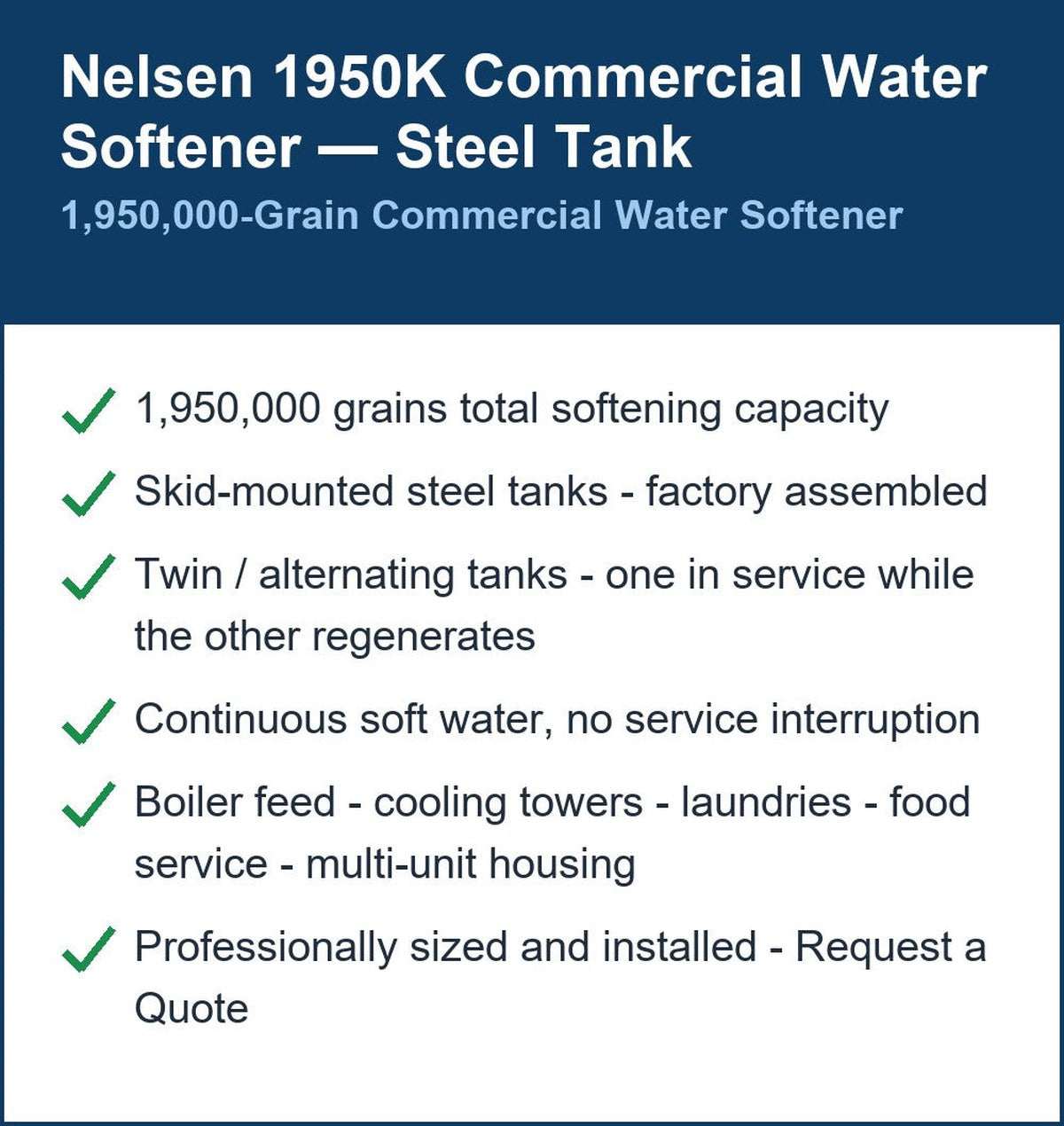
Get a QuoteNelsen 1,950,000 Grain Commercial Water Softener
✓ Free shipping in the USA · ✓ 90-day returns · ✓ Secure checkout

Government Sampling Insights for Hardness in Jackson County
The U.S. Geological Survey’s groundwater sampling in Jackson County’s aquifer 120FLRD reports hardness—measured as calcium and magnesium—in eight samples from five wells, with values ranging from 106.0 mg/L to 179.0 mg/L and a median of 130.0 mg/L. These samples, collected from wells 115 to 234 feet deep between 2011 and 2025, show no hardness levels above any federal thresholds. While this data characterizes the area's groundwater, it does not define the specific hardness in your well or tap water; individual testing is necessary for that.
Calculating Treatment Capacity Against Daily Water Demand
When managing hard water throughout a large home or entire building, treatment capacity must align with total daily water usage rather than individual outlets. The commercial water softener designed for this purpose has a grain capacity of 1,950,000, meaning it can process a substantial volume of hard water minerals before regeneration is needed. Estimate your facility's daily usage by considering all water outlets and processes combined. Matching this demand with the softener’s capacity ensures effective treatment without interruption and optimizes performance for whole-building coverage.
What You Can Expect from Water After Softening
Once water passes through the commercial water softening system, hardness minerals are reduced, which generally prevents scale buildup on pipes, fixtures, and appliances across the entire building. The softened water feel is often described as smoother, and it tends to improve soap and detergent effectiveness in large-scale cleaning operations on-site. However, water composition changes only in hardness; other water quality factors remain unchanged. The system ships ready to configure for integration into your building’s water supply.
Understanding Terms in the Sampling Record
The terms detected, median, and range in the government report describe measurement details: ’detected’ means the hardness minerals were found in all samples; ’median’ is the middle value when results are ordered, representing typical hardness levels in the sampled wells; and ’range’ shows the difference between the lowest and highest values recorded. None of these terms imply safety issues or violations—only the occurrence and variability of hardness minerals over time and location.
Routine Maintenance for the Commercial Water Softener
The softening unit requires periodic maintenance to sustain effective performance. This involves replenishing the mineral or salt media, checking for system wear, and monitoring water hardness output to ensure continued treatment quality. The maintenance schedule depends on water usage patterns and hardness levels but generally follows a predictable cycle that you can plan around. The system is designed to be user-friendly and does not demand extensive technical labor.
Comparing Jackson County to Nearby Areas Without Overreach
When comparing hardness figures in Jackson County’s aquifer with neighboring counties, recognize that each area's water source characteristics and well depths vary, so differences in hardness values may reflect natural variation rather than changes in water quality or safety. Government sampling provides regional snapshots but should not be used to infer conditions for individual properties across counties. Always rely on direct water testing at your site for precise treatment decisions.
In summary, this page outlined how government data informs expectations of hard water in Jackson County's aquifer 120FLRD while emphasizing the need to assess your building’s total water demand to select appropriate treatment capacity. It also described how softened water differs at the tap, clarified sampling terminology, reviewed maintenance needs, and cautioned against overinterpreting regional comparisons when considering whole-building water softening solutions.
Where this information comes from
Source: USGS groundwater sampling. Sampled 2025-09-24. These figures describe groundwater sampled in this area. They are not a test of any individual private well - only a test of that well can establish its own water.
On record: U.S. Geological Survey sampling of Hardness, Ca, Mg in the 120FLRD aquifer (Jackson County): 8 results from 5 wells, median 130.0 mg/L, range 106.0-179.0 mg/L; none above any federal threshold