
Limescale Challenges in Butler County Commercial Water: Plumb Materials, Standards, and Treatment Insights
Pricing: request a quote
Get a Quote1,200,000 Grain Skid-Mounted Commercial Water Softener
✓ Free shipping in the USA · ✓ 90-day returns · ✓ Secure checkout

Interpreting Water Hardness Laboratory Reports and Their Constituents
Commercial operators evaluating limescale issues typically start with laboratory reports that quantify calcium and magnesium concentrations in water samples, reported collectively as water hardness in milligrams per liter (mg/L). These reports reflect measured hardness levels but do not specify the absence or presence of limescale in your particular system. The data represents samples taken from wells in your area, offering a regional perspective rather than a site-specific evaluation.
The Role of Plumbing Material and Age Separate from Source Water
While the hardness of source water contributes significantly to limescale formation, the age and material composition of plumbing infrastructure also influence scale accumulation. Older pipes made from materials like galvanized steel or copper may accentuate scale buildup due to surface conditions favoring mineral adherence. Conversely, newer materials such as PEX or PVC are less prone to limescale attachment. When considering treatment options, it is crucial to account for your facility's plumbing characteristics independently from regional water hardness data.
Why Aesthetic Secondary Standards Differ from Health-Based Limits
The U.S. Environmental Protection Agency (EPA) establishes secondary standards for constituents like hardness to address aesthetic concerns such as taste, staining, and scaling potential. These standards are advisory and distinct from enforceable health-based limits set to protect human health. The Butler County aquifer 112OTSH data show hardness levels well below any federal health thresholds, indicating no safety violations but a potential for aesthetic and operational impacts due to limescale.
A Worked Example: Reading Butler County Aquifer Median and Range
The U.S. Geological Survey sampled 15 hardness values from 12 wells in Butler County’s 112OTSH aquifer between 2010 and 2020. The median hardness recorded was 358 mg/L, with values ranging from 135 to 494 mg/L. This range indicates variability across local wells but consistently detectable hardness. Commercial operators can use such data as a preliminary guide, remembering that individual well testing remains essential for precise hardness assessment and subsequent decisions.
How Many Samples and Wells Support These Figures and What It Means
The dataset comprises 15 samples from 12 distinct wells with depths between 32 and 92 feet. While this sampling density offers a reasonable regional overview, it does not replace comprehensive testing of your commercial facility’s water supply. Multiple samples over time and from various supply points on your property will provide the best characterization of your water's limescale potential.
Consequences of Untreated Limescale in Commercial Applications
When hard water passes untreated, limescale can accumulate on heat exchangers, valves, and pipe interiors, leading to reduced efficiency, increased maintenance needs, and potential equipment downtime. Over time, scale buildup increases energy consumption as heating elements work harder, affecting operational budgets. Recognizing these consequences without exaggeration underscores the importance of understanding your water characteristics and implementing appropriate management strategies.
How Treated Water Differs at the Tap with Commercial Water Softening
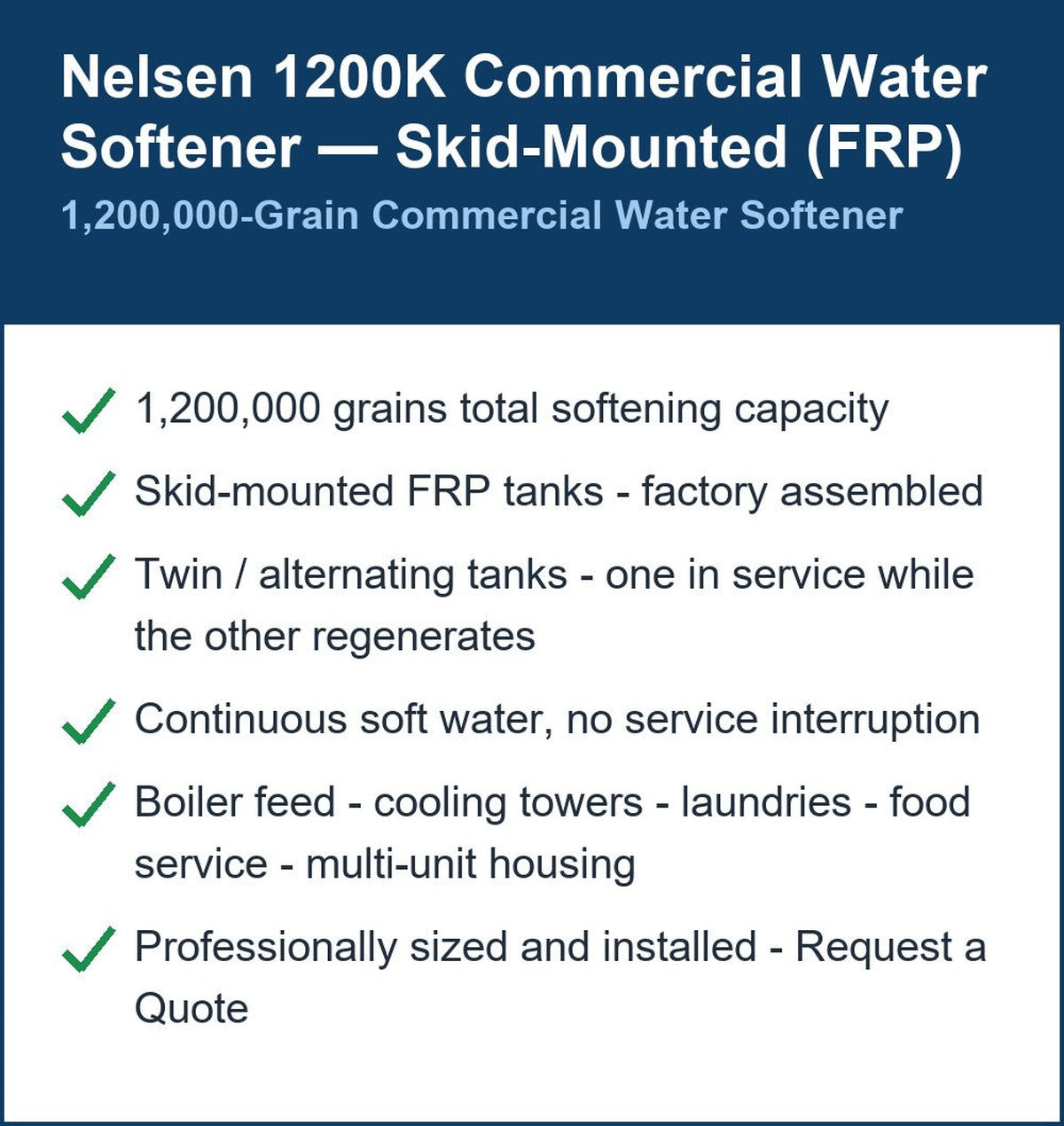
Water treated by commercial water softening equipment removes the calcium and magnesium ions responsible for limescale formation, resulting in water that minimizes mineral deposits on plumbing surfaces and equipment. This treatment enhances operational efficiency and extends equipment life by reducing scale accumulation. The Nelsen 1,200,000 Grain Skid-Mounted Commercial Water Softener ships ready to configure and is designed to meet substantial commercial water demands, effectively managing hardness levels consistent with those documented regionally in Butler County’s aquifer 112OTSH.
For commercial operators comparing equipment classes, understanding these factors and the documented performance of a commercial water softener with a 1,200,000 grain capacity can support informed decisions tailored to your operation’s requirements.
Where this information comes from
Source: USGS groundwater sampling. Sampled 2020-11-18. These figures describe groundwater sampled in this area. They are not a test of any individual private well - only a test of that well can establish its own water.
On record: U.S. Geological Survey sampling of Hardness, Ca, Mg in the 112OTSH aquifer (Butler County): 15 results from 12 wells, median 358.0 mg/L, range 135.0-494.0 mg/L; none above any federal threshold