
Managing Limescale Risks in Leflore County Industrial Water Systems with Process Constraints
Pricing: request a quote
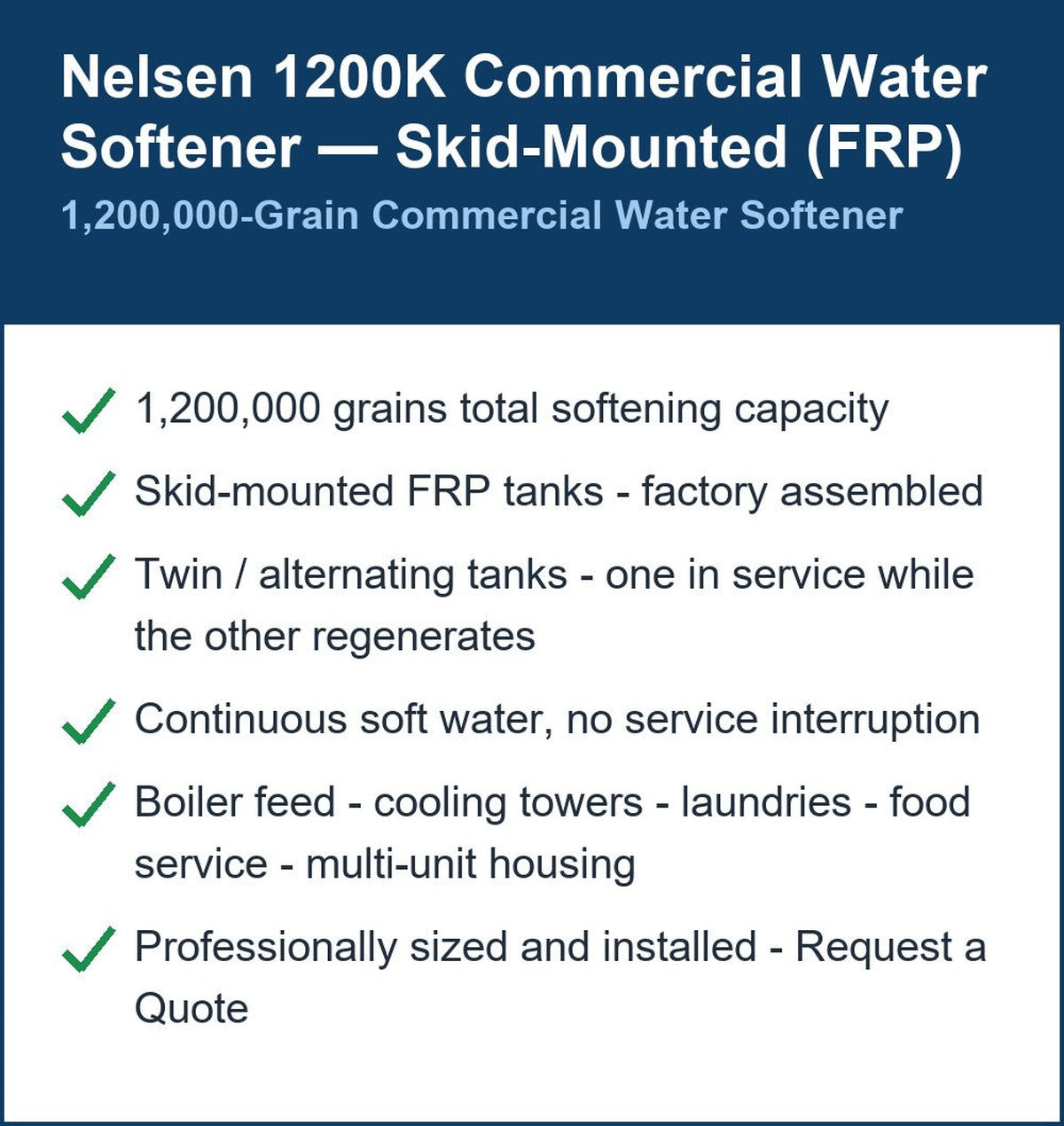
Get a QuoteNelsen 1,200,000 Grain Skid-Mounted Commercial Water Softener
✓ Free shipping in the USA · ✓ 90-day returns · ✓ Secure checkout

Recognizing Facility Symptoms That Relate to or Exclude Limescale Formation
In industrial process water management, visible or operational symptoms can guide the suspicion of limescale buildup. Signs often include reduced heat exchange efficiency, scaling deposits on equipment surfaces, increased maintenance demands, and disrupted flow rates. Conversely, issues such as microbial fouling, corrosion with pitting, or sediment accumulation without mineral deposits typically do not indicate limescale. Distinguishing limescale-related problems from other faults is crucial given the tight process-water specifications affecting many industrial operations.
Understanding Hardness Levels in Leflore County Aquifer Samples Versus Federal Standards
According to U.S. Geological Survey data for Leflore County's aquifer labeled 112MRVA, hardness measured as calcium and magnesium ranged from 41.6 to 464.0 mg/L over 21 samples from 12 wells between 2016 and 2020. The median hardness result was 230.0 mg/L. These measurements, while variable, fall below any federal health-based limits, which are not specifically set for hardness but are used primarily as an aesthetic or operational guideline. This means the water's hardness level alone is not a federal violation nor a direct health concern, but it is relevant for controlling scale formation in industrial systems.
Critical Information to Document Before Consulting or Proceeding with Limescale Treatment Options
Before seeking advice on water treatment options to prevent or reduce limescale buildup, facilities should record several key pieces of information:
- Process-water flow rates and volumes
- Temperature profiles where water contacts equipment
- Recent water quality test results focused on hardness constituents (calcium and magnesium)
- Frequency and location of observed scale deposits or operational impacts
- Any current water treatment equipment details
Having this data helps clarify the scope and severity of limescale challenges and any limitations dictated by process specifications.
Distinguishing Public-Area Aquifer Sampling from Private Well Testing in Water Quality Assessment
Publicly available sampling data from the USGS provides an overview of the hardness range in Leflore County's aquifer 112MRVA. However, this data reflects multiple wells of varying depths and locations, collected over several years and is not a substitute for a current, site-specific test. Private well sampling or specific process water testing is necessary to determine exact local conditions affecting a particular industrial facility. This distinction is essential when setting treatment parameters to meet precise process-water specifications.
Changes in Water Quality at the Facility After Applying the Documented Water Treatment Technology
Deploying a Nelsen 1,200,000 Grain Mineral-Tank Commercial Water Softener addresses limescale by exchanging calcium and magnesium ions that cause hardness with sodium or potassium ions, significantly reducing mineral hardness levels in the treated water. This process yields water less likely to form scale deposits on equipment surfaces, thereby improving process reliability and reducing maintenance downtime. The treated water maintains compliance with industrial water specifications and helps protect sensitive processing components from adverse mineral buildup.
In summary, understanding local hardness levels from public records provides a general context but does not replace comprehensive testing of your own water source. Recognizing facility-level symptoms and documenting relevant water and process data are important steps before selecting a treatment solution. Using a commercial water softener such as the Nelsen 1,200,000 Grain Mineral-Tank model can effectively mitigate limescale issues within the constraints of industrial process-water specifications.
Where this information comes from
Source: USGS groundwater sampling. Sampled 2020-07-23. These figures describe groundwater sampled in this area. They are not a test of any individual private well - only a test of that well can establish its own water.
On record: U.S. Geological Survey sampling of Hardness, Ca, Mg in the 112MRVA aquifer (Leflore County): 21 results from 12 wells, median 230.0 mg/L, range 41.6-464.0 mg/L; none above any federal threshold