
Limescale Challenges in Umatilla County and Managing Industrial Throughput
Pricing: request a quote
Get a Quote1,200,000 Grain Skid-Mounted Commercial Water Softener
✓ Free shipping in the USA · ✓ 90-day returns · ✓ Secure checkout

Identifying Industrial Symptoms Related to Limescale
Industrial facilities experiencing limescale typically notice scale buildup on pipes, heat exchangers, or boilers, leading to reduced efficiency. Not every water-related operational hiccup indicates limescale; for example, corrosion or biological fouling have different causes and treatments.
Potential Consequences of Ignoring Scale Formation Over Time
If limescale is left untreated, industrial equipment can suffer diminished throughput as scale deposits constrict water flow and impair heat transfer. This can increase energy consumption and maintenance frequency, potentially causing unplanned downtime between service events.
Interpreting U.S. Geological Survey Hardness Data for Umatilla County Aquifer
Government sampling from a well in the Umatilla County aquifer measured water hardness with a median of 176 mg/L and a range from 161 to 239 mg/L, based on 12 samples taken over three years. These values reflect calcium and magnesium concentrations contributing to limescale potential but are not specific to any one industrial facility's water supply. No federal threshold was exceeded in these samples, indicating no regulatory violation, though the hardness levels indicate a capacity for scaling.
Evaluating Treatment Capacity Relative to Facility Water Demand
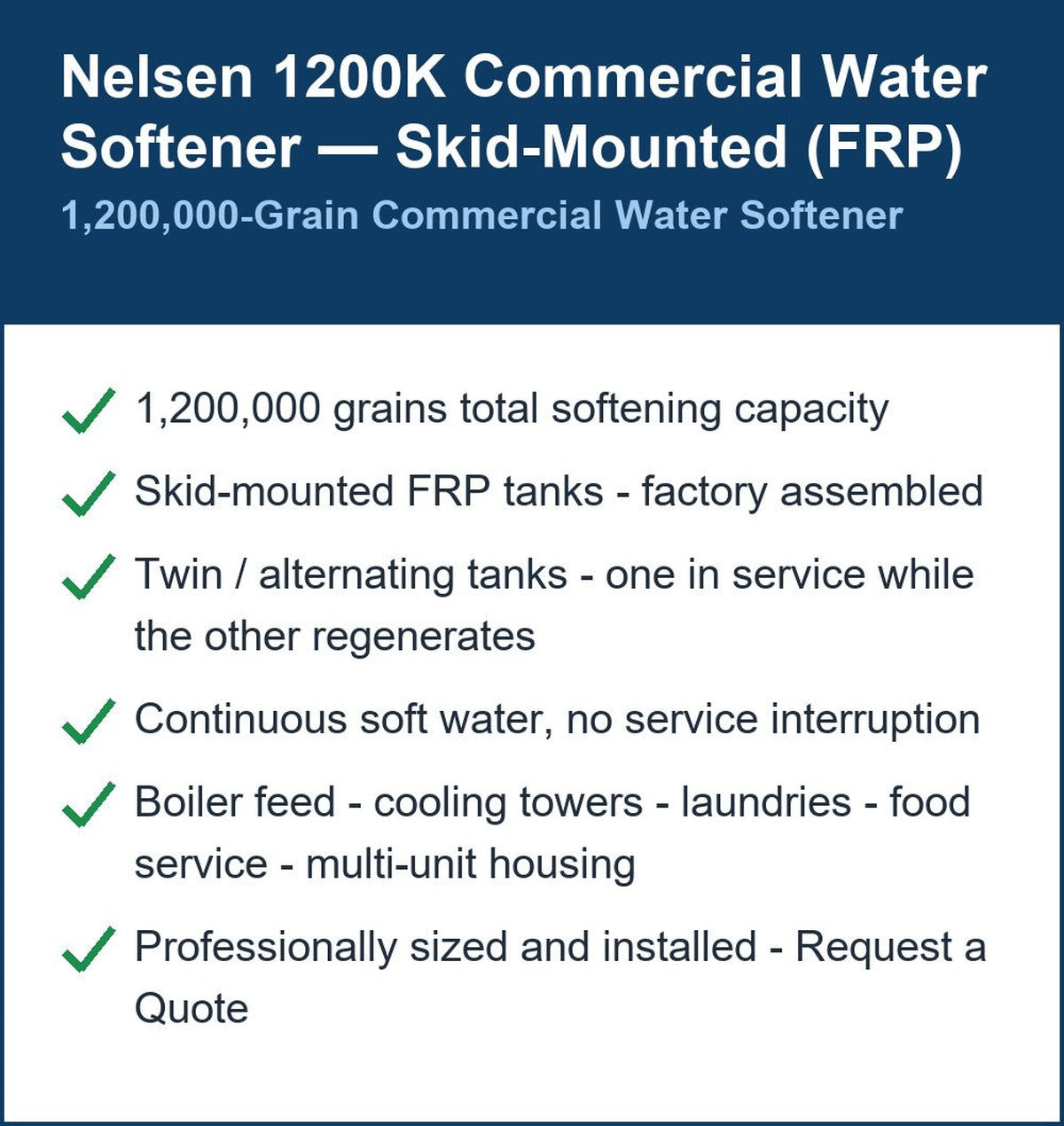
To ensure continuous operation without throughput reduction, it is necessary to select a water treatment system capable of handling the volume and hardness load of the process water between service intervals. The Nelsen 1,200,000 Grain Mineral-Tank Commercial Water Softener offers a documented capacity that can match industrial throughput by reducing hardness ions effectively over extended periods.
How Commercial Water Softeners Control Hardness and Scale Formation
Commercial water softeners work by exchanging hardness minerals such as calcium and magnesium for sodium or potassium ions, thereby preventing these minerals from precipitating as scale on equipment surfaces. This process helps maintain pipe integrity and heat exchange efficiency without altering the overall water volume or requiring frequent intervention.
Distinguishing Aesthetic Secondary Standards from Health-Based Limits
Water hardness is governed by aesthetic secondary standards related to taste, staining, and scaling rather than health-based limits. While the hardness levels measured in Umatilla County suggest potential for mineral deposits, these concentrations do not pose a health risk but can affect industrial equipment performance and longevity.
Recommended Testing to Confirm Water Treatment Needs
To determine the appropriate water treatment for your facility, order a comprehensive hardness test of your process water. Confirming calcium and magnesium levels specific to your supply will clarify the extent of limescale risk and the capacity your water softener requires to maintain optimal throughput between service events.
Where this information comes from
Source: USGS groundwater sampling. Sampled 2019-04-16. These figures describe groundwater sampled in this area. They are not a test of any individual private well - only a test of that well can establish its own water.
On record: U.S. Geological Survey sampling of Hardness, Ca, Mg in the N100CMBPLB aquifer (Umatilla County): 12 results from 1 wells, median 176.0 mg/L, range 161.0-239.0 mg/L; none above any federal threshold