
Water Heater Scale in Union County: Assessing Local Water Hardness Range for Commercial Buildings
Pricing: request a quote
Get a Quote1,950,000 Grain Commercial Water Softener
✓ Free shipping in the USA · ✓ 90-day returns · ✓ Secure checkout

If you notice scale buildup in your commercial water heater or throughout the building’s plumbing
Start by noting the extent and locations of scale deposits, such as inside hot water tanks, on heating elements, or around pipe fittings. Document whether the scale appears uniformly or is concentrated in certain areas. Also track water use patterns and any changes in water appearance, taste, or pressure that accompany scaling.
If you want to understand what the Union County aquifer 124SPRT water hardness data means for your facility
According to U.S. Geological Survey groundwater sampling from July 2012 to September 2019, area wells at 260 to 771 feet deep showed hardness—as calcium and magnesium combined—in a range from 1.75 mg/L to 51.0 mg/L, with a median value of 4.43 mg/L. These figures describe the water in this aquifer zone but do not indicate the exact hardness of water entering your building.
If you are wondering how this range compares to federal standards and what that implies
None of the measurements from the 14 samples from 11 wells exceeded any federal threshold for hardness. Hardness itself is not regulated as a health hazard by federal agencies; rather, it is managed mainly for aesthetic and operational concerns related to scale, taste, and cleaning efficiency. Therefore, detection within this range does not signify water safety issues but signals potential for scale buildup depending on concentration at your point of use.
If you consider the impact of your building’s plumbing materials and system age on scale formation
Older pipes or water heaters made from certain metals may accumulate scale deposits differently than newer systems or those using alternative materials. The type of plumbing can affect how hardness minerals precipitate and form scale inside pipes and tanks. Thus, plumbing characteristics are a factor independent of raw water hardness when evaluating water heater scale.
If you are assessing which facility symptoms relate to water heater scale versus other issues
Scale buildup typically shows as hardened mineral layers inside water heaters, reduced heating efficiency, clogged pipes, or decreased water flow. However, water discoloration or odor generally stems from other causes and should be investigated separately. Confirming scale presence often requires inspection or testing beyond observing symptoms alone.
If your commercial operation involves treating an entire building rather than individual outlets
Whole-building treatment demands equipment designed for high flow and large volume capacities. Systems sized for residential use do not address the scale control needs of commercial facilities adequately. Water hardness levels and building water demands measured or estimated should guide selection of water treatment technology.
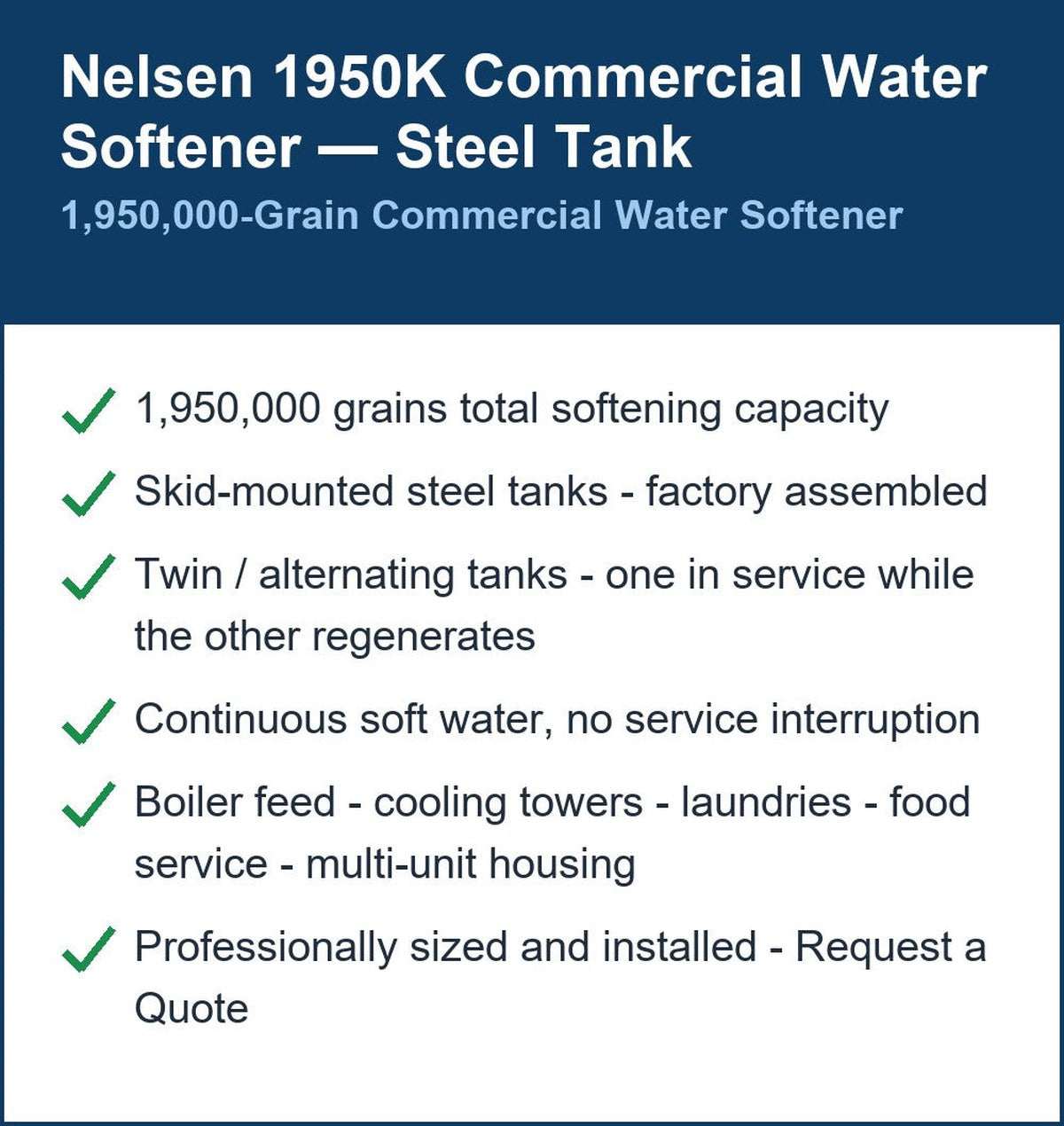
To address scale buildup reliably in this setting, a Nelsen 1,950,000 Grain Commercial Water Softener ships ready to configure for whole-building use. Its grain capacity matches the scale prevention requirements documented for large-volume water users drawing from Union County’s 124SPRT aquifer area.
Where this information comes from
Source: USGS groundwater sampling. Sampled 2019-09-18. These figures describe groundwater sampled in this area. They are not a test of any individual private well - only a test of that well can establish its own water.
On record: U.S. Geological Survey sampling of Hardness, Ca, Mg in the 124SPRT aquifer (Union County): 14 results from 11 wells, median 4.43 mg/L, range 1.75-51.0 mg/L; none above any federal threshold